
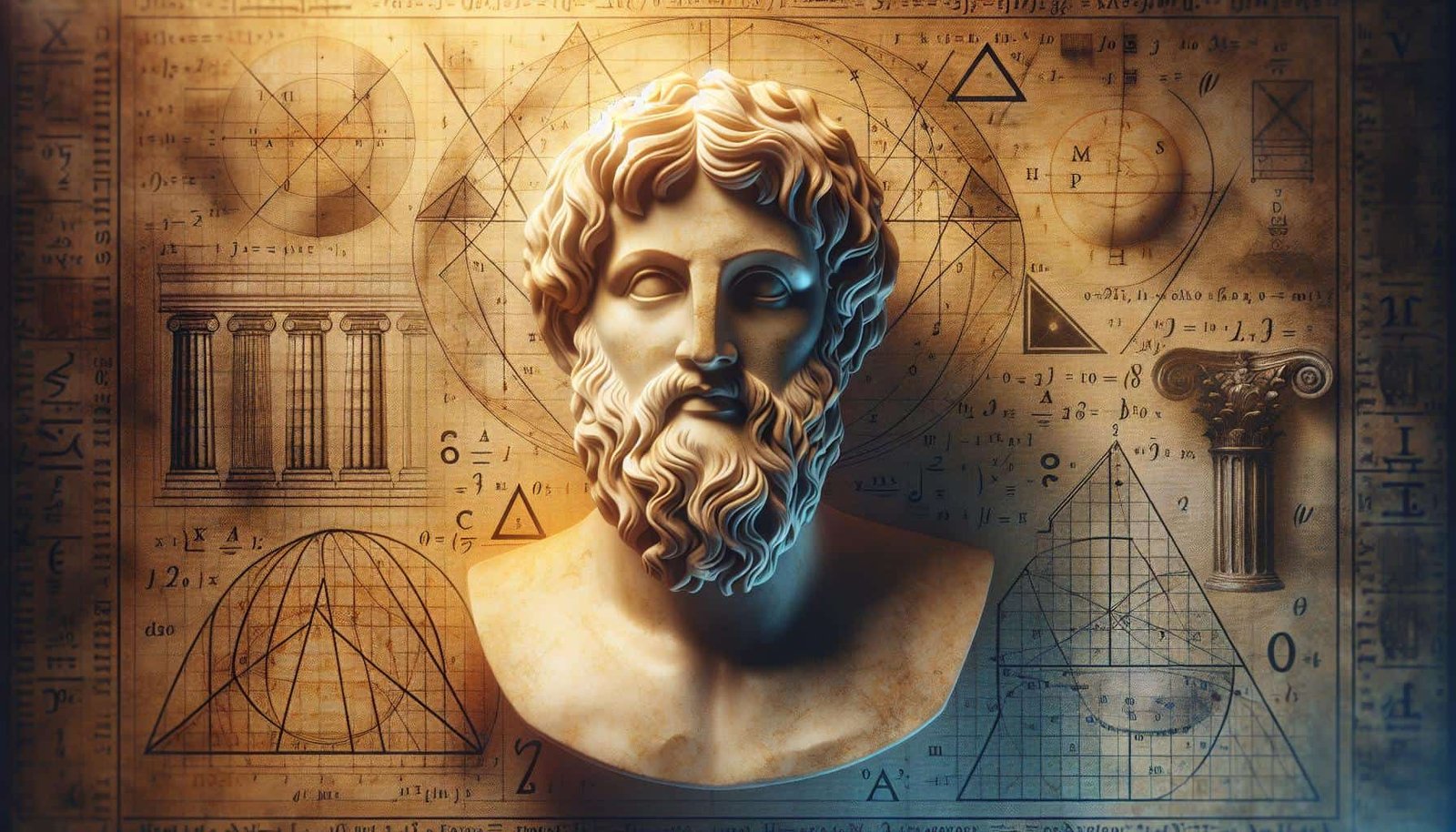
The Life of Pythagoras
Pythagoras, a monumental figure in history, influenced more than just mathematics. His life story reveals a complexity that resonates through various fields, including music, philosophy, and mysticism.
Early life and education
Pythagoras was born around 570 BCE on the island of Samos. His early life remains somewhat enigmatic but hints at a fascination with knowledge that transcended the ordinary. You might find it intriguing that Pythagoras traveled extensively, seeking wisdom from Egypt, Babylon, and other ancient cultures. His education was not merely academic; it intertwined with spiritual philosophies, shaping his worldview. Influences from both mathematics and metaphysics ignited his intellectual curiosity, laying the groundwork for his future teachings.
Contributions to mathematics
Pythagoras transformed mathematics, establishing principles that remain foundational today. His most renowned contribution, the Pythagorean theorem, illustrates the relationship between the sides of a right triangle. This theorem is not just a formula; it embodies a deeper understanding of geometric relationships. Beyond triangles, Pythagoras explored numerical relationships, emphasizing the significance of integers and their harmonic properties. He believed numbers had inherent meanings, connecting them to universal truths. You might appreciate how these concepts influence various fields, from music theory to physics. Pythagoras’s legacy continues to echo through academia, challenging you to explore mathematics beyond rote memorization and into the area of beauty and harmony.
I suggest you read Why diogenes is the ultimate dark academia icon for you
Explore more about these fascinating ideas and investigate into the interconnectedness of all realms of learning at Dark Academia Codex, your gateway to the rich aesthetic of classical knowledge and thought.
The Pythagorean Theorem
The Pythagorean theorem illustrates a foundational relationship in mathematics, specifically within right triangles. This theorem states that the square of the length of the hypotenuse equals the sum of the squares of the lengths of the other two sides. Its formula, expressed as ( a^2 + b^2 = c^2 ), encapsulates a significant geometric concept.
Understanding the formula
Understanding the formula requires recognizing the variables involved. Here, ( a ) and ( b ) represent the lengths of the two shorter sides, while ( c ) signifies the hypotenuse. For instance, in a triangle with side lengths of 3 and 4, applying the formula reveals ( 3^2 + 4^2 = 9 + 16 = 25 ). The hypotenuse measures 5, confirming the equation. This relationship extends beyond triangles, serving as a crucial element in various mathematical applications, including trigonometry and algebra.
I suggest you read Embracing ataraxia: discover peace amid chaos today
Applications in everyday life
Applications of the Pythagorean theorem permeate daily life. You frequently use it, perhaps unknowingly, in activities such as carpentry, navigation, and even in creating artistic compositions. For example, when determining the diagonal length of a rectangular object, like a tabletop, the theorem simplifies calculations. In navigation, it assists in calculating the shortest path between two points, enhancing efficiency. The Pythagorean theorem not only underpins architectural endeavors but also inspires a broader appreciation for geometry’s role in understanding our world. Explore these concepts further on the Dark Academia Codex to enrich your academic journey.
Beyond Triangles: Pythagoras’ Influence
Pythagoras’ impact extends far beyond the area of triangles, influencing various disciplines and thought processes.
Pythagorean triples
Pythagorean triples showcase sets of three positive integers ( (a, b, c) ) that satisfy the Pythagorean theorem’s condition. Common examples include ( (3, 4, 5) ) and ( (5, 12, 13) ). These triples reveal more than just mathematical relationships; they demonstrate the elegance of numbers. In practical applications, architects and builders use Pythagorean triples to guarantee right angles in constructions. Discovering Pythagorean triples can evoke a sense of wonder similar to unraveling a poetic mystery. The study of these integers reinforces the interconnectedness of mathematics and art, echoing the principles found in Dark Academia.
I suggest you read How to channel your inner Socrates in everyday life today
Connection to other mathematical concepts
Pythagoras’ ideas intertwine with various mathematical concepts, forming a foundation for future exploration. Geometry, number theory, and trigonometry all derive principles from Pythagorean thought. The theorem influences discussions on distance and spatial relationships, paving the way for advanced explorations in Euclidean and non-Euclidean geometries. Delving into Pythagorean concepts enriches your understanding of mathematical beauty. Pythagoras’ emphasis on ratios also connects to musical harmonics, illustrating a fascinating link between math and art. Explore this intersection further through the resources available on Dark Academia Codex for a deeper insight into these captivating subjects.
Pythagoras in Philosophy and Science
Pythagoras’s influence extends beyond geometry into philosophy and science, merging numerical significance with metaphysical ideas. His thoughts on the nature of reality provoke exploration into the interconnectedness of existence.
The role of numbers in philosophy
Numbers embody more than mere quantities; they represent universal truths. Pythagoras viewed numbers as the essence of all things, connecting them to the cosmos and human experience. For instance, he linked harmony in music to numerical ratios, suggesting that beauty arises from mathematical relationships. The famous harmony of the spheres theory implies that celestial bodies move according to mathematical equations, contributing to a cosmic symphony. These ideas encourage you to contemplate the deeper significance of numbers, beyond their arithmetic applications.
Pythagoreanism and its legacy
Pythagoreanism emerged as a philosophical movement, blending mathematics, ethics, and mysticism. This system emphasized the significance of numerology and the belief in the immortality of the soul, fostering a worldview where numbers governed the cosmos. Pythagorean thought influenced Plato, which in turn shaped Western philosophy. The legacy persists in contemporary fields, including mathematics and philosophy, underscoring the importance of logical reasoning and the interrelation of disciplines. Engaging with Pythagorean concepts invites exploration into fundamental questions about existence and knowledge. Dive deeper into these ideas on the Dark Academia Codex, where the aesthetic and intellectual richness of classical learning awaits you.
Pythagoras’s legacy transcends the boundaries of mathematics, inviting you to explore a world where numbers and philosophy intertwine. His insights challenge you to rethink the connections between disciplines and appreciate the beauty inherent in mathematical relationships.
By delving into Pythagorean thought, you uncover a rich world of ideas that continue to resonate in modern science, art, and philosophy. Embracing this knowledge can deepen your understanding of the universe and your place within it, encouraging a holistic view of learning and existence.
As you reflect on Pythagoras’s influence, consider how these timeless principles can inspire your own journey of exploration and discovery.
